31 Aug 2026 · Rehurz
What Is a Training and Placement Cell? Roles, Challenges, and the 2026 Playbook for Closing the Readiness Gap
A training and placement cell (T&P cell) is the department inside a college or university that connects students with employers, builds job-ready skills, and runs the recruitment process that turns a degree into an offer letter. Nearly every AICTE-approved engineering and management institute in India runs one, typically under a Training and Placement Officer (TPO).
This guide covers what a T&P cell actually does, how it is usually structured, the problems most cells run into once a batch grows past a few hundred students, and what is changing in how colleges prepare students for interviews.
Quick Answer
- A T&P cell (or TPO office) handles training, corporate outreach, and placement drives for a college's graduating batches.
- Its job has shifted from "get companies to visit campus" to "prove students are actually interview-ready before companies arrive."
- Only 9% of employers think fresh graduates are job-ready on day one, even though 68% of students believe they are, according to HirePro's State of College Hiring in India 2026 report.
- The most common bottleneck is scale: faculty cannot realistically give hundreds of students real one-on-one mock-interview practice every placement season.
- Structured, AI-assisted mock interviews are becoming a standard way for T&P cells to close that gap without adding headcount.
What Is a Training and Placement Cell?
A training and placement cell sits inside the institution, usually reporting to the Principal or Director, and exists to do three things: build employability skills in students, bring recruiters to campus, and run the logistics of the placement season itself, from registration through to offer letters. Some institutions use different names for the same function: Corporate Relations Cell, Career Development Centre, or simply the Placement Office. Outside India, the closest equivalent is a university's career services office, though the Indian T&P cell model is generally more tightly built around scheduled, on-campus recruitment drives.
A well-run cell works across the full student lifecycle rather than only in the final semester: aptitude and communication training in the earlier years, resume building and domain-specific preparation as placements approach, and interview coordination once companies confirm campus visits.
Why Training and Placement Cells Matter
Two figures explain why this department carries more weight than its size on an org chart suggests.
First, employability is improving nationally but still leaves a large share of graduates short. The India Skills Report 2026, compiled by Wheebox and ETS with CII, AICTE, and AIU, put overall employability at 56.35%, up from 54.81% the year before. Engineering graduates came in just above 70%. That is genuine progress, and it still means a meaningful share of every engineering batch is not considered job-ready by the employers assessing them. The same report found that employers consider 72% of undergraduate curricula out of step with what hiring actually requires, which is part of why the T&P cell, not the curriculum committee, ends up carrying the burden of closing the gap on a tight timeline.
Second, and more specific to what a T&P cell actually controls: readiness is largely a perception problem until it gets tested. HirePro's State of College Hiring in India 2026 report, based on responses from over 10,000 students, 80-plus corporates, and 100-plus colleges and campus recruiters, found that 68% of students believe they are job-ready from day one, while only 9% of employers agree. That 59-point gap is not a motivation problem. It is a feedback problem: most students never get honest, structured signal on how they actually perform in an interview until the interview that counts.
A T&P cell is the one part of the institution positioned to close that gap before a recruiter does it for them, in public, during a placement drive.
What a Training and Placement Cell Actually Does
Industry and Corporate Relations
The cell builds and maintains relationships with recruiters: sharing pre-placement information, negotiating drive dates, and keeping a working record of which companies visited, for which roles, and at what packages. This is relationship management as much as it is administration, and it is what determines how many companies show up each season.
Training and Skill Development
This covers aptitude training (quantitative, logical reasoning, verbal), technical training in each department's core domains, and soft-skill work such as group discussions, resume writing, and communication. Larger cells run this through a mix of in-house faculty and external trainers; smaller ones lean almost entirely on faculty time.
Mock Interviews and Interview Readiness
This is the most resource-intensive function, and the one most exposed to the scale problem described later in this guide. Traditionally it means faculty or senior students volunteering to run practice HR and technical rounds, which works well for a handful of motivated students and badly for a batch of several hundred.
Placement Drive Coordination
Once companies confirm visits, the cell manages the logistics: scheduling, booking interview and group-discussion rooms, running online assessments, tracking attendance, and handling the documentation that placement statistics and offer letters require.
Career Counselling
Not every student is placement-bound. The cell also advises students heading toward higher studies, entrepreneurship, or family business, and helps placement-bound students figure out which roles and companies actually fit their strengths.
Outcome Tracking and Reporting
Placement statistics feed directly into NAAC and NBA accreditation and NIRF-style rankings, and they are core marketing material for attracting the next incoming batch. Institutions are increasingly expected to track outcomes beyond the offer letter itself, including whether students actually joined and stayed.
How a Training and Placement Cell Is Structured
Most cells share a similar shape, even when the titles differ slightly between institutions:
- Training and Placement Officer (TPO), sometimes titled Director or Dean of Placements at larger universities, who heads the cell and reports to the Principal or Director.
- Faculty placement coordinators, usually one per department, who act as the link between the central TPO office and their department's students.
- Student placement representatives, senior students who help with logistics, communication, and sometimes peer-led mock interviews.
- Corporate relations staff, at larger institutes, whose job is dedicated recruiter outreach rather than student-facing training.
- Physical and digital infrastructure: interview rooms, group-discussion rooms, a computer lab for online assessments, and increasingly a dashboard or ERP module for tracking registrations, attendance, and outcomes.
At a standalone college, the TPO typically reports straight to the Principal. At a university with multiple constituent colleges, a Dean of Placements or Director of Career Services often coordinates department-level TPOs across campuses.
Five Problems Every Training and Placement Cell Runs Into
1. Faculty time does not scale to real interview practice. A cell with two or three coordinators and a graduating batch of 600 cannot give every student even one properly run mock interview, let alone the several repetitions most skill-building research suggests are needed before performance under pressure actually improves.
2. Prep quality depends on who a student happens to get. A student paired with an engaged senior or a faculty member who takes mocks seriously gets meaningfully better preparation than one paired with someone treating it as a formality. That inconsistency shows up directly in outcomes and is hard to defend when a recruiter, or an accreditation body, asks how prep quality is standardized across the batch.
3. Readiness is a guess until recruiters show up. Aptitude scores and CGPA are usually the only hard numbers a cell has going into placement season, and neither measures how a student performs in a real conversation: explaining a project clearly, handling an unplanned follow-up question, or recovering from a wrong answer without losing composure.
4. Aptitude tests and MCQs measure recall, not interview performance. A student can score well on a written test and still freeze in a live technical round, because the two are testing different things entirely: recognition under low pressure versus real-time articulation under evaluation. Rehurz has written about this exact gap in the context of corporate training, and the same logic applies to campus assessment.
5. Outcome data lives in spreadsheets, not in a system anyone can act on. Most cells can report a final placement percentage. Far fewer can point to the specific weakness, communication, a technical area, or composure under follow-up questions, that held back the students who did not get placed, because that data was never captured in a structured way to begin with.
How Technology Is Changing Placement Preparation
The common thread across all five problems above is the same: they are all, at root, a scale problem. A cell with unlimited faculty hours could solve every one of them with more one-on-one attention. No cell has unlimited faculty hours.
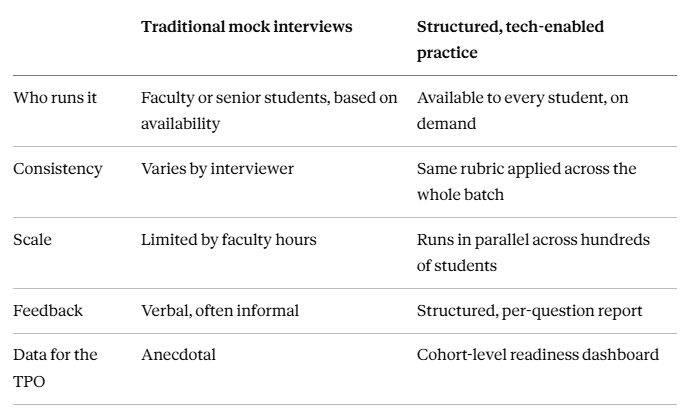
This is the specific gap that AI-driven mock interview platforms are built to close. Instead of a senior student or an available faculty member running an ad hoc practice session, a student takes a structured, voice-based interview against a fixed rubric, on their own schedule, and gets an evaluated report back immediately rather than whatever verbal feedback they happened to receive in the room.
Rehurz's institution workspace is built specifically around this batch-level version of the problem. A T&P cell uploads a CSV of the graduating batch, invites the whole cohort in one pass, and each student interviews on their own time across more than 20 domains, evaluated against the same rubric every time. What comes back is not just a per-student score but a cohort readiness dashboard the TPO can actually use: who has practiced, who is ready, and who still needs targeted help, without a coordinator sitting in on hundreds of individual sessions. Because it runs in the browser and follows DPDP Act 2023 data-handling requirements, it slots into an existing placement calendar rather than replacing it.
None of this replaces the corporate relations work, the counselling, or the judgment a TPO brings to a placement season. What it changes is which problems a cell has to solve by hand. Structured practice becomes something every student gets by default, and human time gets reserved for the students and situations that genuinely need a person.
A Practical Playbook for Strengthening Your T&P Cell
Start readiness-building in year two, not the final semester. Confidence and interview performance are built through repetition over time, not a two-week crash course before recruiters arrive. Cells that begin structured mock-interview practice from the second year tend to produce more consistent final-year outcomes than those that compress everything into one placement season.
Standardize the rubric before you standardize anything else. If ten faculty members run mock interviews with ten different mental checklists, the feedback students get is not comparable, and the readiness data the TPO reports upward is not defensible. Pick one evaluation rubric per domain and apply it everywhere, whether the interview is run by a person or a platform.
Give every student real repetitions, not just the ones who ask for extra help. The students least likely to seek out extra mock-interview time are often the ones who need it most. Building practice into the default placement-prep workflow, rather than making it opt-in, closes that gap.
Track a readiness signal per student, not just a placed or not-placed outcome. A binary outcome tells you what happened. A readiness score, tracked across multiple sessions, tells you what is likely to happen and where to step in before the real interview.
Personalize preparation by role, not just by department. A computer science student aiming for a product role needs different practice from one aiming for a pure software engineering role. Where possible, route students into domain-specific tracks rather than one generic prep track for the whole department.
Close the loop with recruiter feedback. When a recruiter shares why a candidate was not selected, that reason should feed back into next year's training design, not just sit in that one student's file.
Frequently Asked Questions
What does T&P cell stand for? T&P cell stands for Training and Placement Cell, the department in an Indian college or university responsible for placement training, corporate outreach, and campus recruitment.
Who heads a training and placement cell? A Training and Placement Officer (TPO), sometimes titled Director or Dean of Placements at larger universities, heads the cell and typically reports to the Principal or Director of the institution.
Is a training and placement cell mandatory in engineering colleges in India? AICTE-approved technical institutions are expected to provide active placement support as part of their institutional framework, and a functioning T&P cell is standard practice across accredited colleges. It also directly affects the placement statistics colleges report for accreditation and rankings, which makes it effectively non-negotiable in practice.
What is the difference between a placement cell and a career services office? They serve the same core function under different names. Training and Placement Cell is the term most commonly used in India, while Career Services Office is more common internationally. Both connect students to employers and prepare them for recruitment, though Indian T&P cells are typically built more tightly around scheduled, on-campus drives.
How many mock interviews should a student do before placements? There is no single official number, but most placement trainers recommend several structured mock interviews spread across the final one to two years rather than a single session right before the real thing. The goal is enough repetition that the format itself, not just the content, stops being the source of nervousness.
Can AI mock interviews replace human interview panels in T&P training? No, and they are not built to. What they replace is the assumption that every student can get real one-on-one practice from a person, which most cells cannot deliver at scale. AI-driven mock interviews handle the volume of repetitions every student needs, which frees faculty time for the coaching and judgment calls that genuinely need a person.
Closing
For a T&P cell, placement season does not really start when recruiters arrive on campus. It starts with whether every student in the batch has had a real chance to practice before that day. If your cell is trying to scale structured mock-interview practice across a full batch without adding faculty headcount, Rehurz's institution workspace is built around exactly that problem, from bulk invites to a cohort readiness dashboard. Book a demo to see what it looks like for your next batch.
Publishing notes (not part of the article)
Suggested SEO title tag (59 characters): Training and Placement Cell: Roles, Challenges & 2026 Guide
Suggested meta description (150 characters): A complete guide to training and placement cells: core functions, common challenges, and how AI mock interviews help colleges close the readiness gap.
Suggested URL slug: /blog/training-and-placement-cell-guide-2026
Primary keyword: training and placement cell
Secondary keywords: T&P cell, training and placement officer, TPO role, placement cell functions, campus placement preparation, AI mock interviews for colleges, placement readiness gap
Recommended schema: Article schema on the page, plus FAQPage schema for the FAQ section (JSON-LD below, text matches the visible FAQ exactly so it stays eligible for rich results).
Why this is built for AEO and GEO, not just SEO:
- The Quick Answer block and every FAQ answer are self-contained, extractable statements, so an AI answer engine or featured snippet can lift them without needing surrounding paragraphs for context.
- Every statistic is attributed by name to its source report (India Skills Report 2026, HirePro's State of College Hiring in India 2026), which gives both search crawlers and answer engines something concrete to verify and cite back to.
- Headings are phrased as the actual questions TPOs and students search for ("What Is a Training and Placement Cell," "How many mock interviews should a student do"), rather than generic section titles.
- Internal links build topical relevance around interview evaluation (linking to the MCQ and scoring posts) instead of only pointing at the product page.
Want more Rehurz in your Google results?
Add Rehurz as a preferred source