1 Jul 2026 · Rehurz
Why Solving 500 LeetCode Problems Isn't Enough (And The 4-Step Framework to Actually Get Hired)
If you are preparing for software engineering interviews, you are probably spending hours staring at a dark IDE theme, trying to memorize the optimal time complexity for traversing a graph. You finally get the green "Accepted" text on a Hard problem, and you feel ready.
Then the actual interview happens. A senior engineer asks you a slightly modified version of a problem you know. Suddenly, the silence in the room is deafening, you forget how to declare a basic hash map, and your mind goes blank.
What went wrong? You practiced coding, but you didn't practice interviewing.
Coding rounds don't just test if you can find the optimal algorithm. They test your engineering hygiene, your ability to take hints, and how you communicate under pressure. Here is the framework to transition from a passive problem solver to a hireable engineer.
The "Passive Grinding" Trap
The biggest mistake candidates make is treating interview prep like a math exam. When you practice alone, you develop bad habits:
- Jumping straight into writing code before fully understanding the constraints.
- Writing sloppy variable names (
x,y,temp) because no one else is reading it. - Solving the problem in complete silence.
In the real world, a hiring manager wants to know what it is like to debug a production outage with you. If you code in silence and suddenly arrive at a solution, they have no idea how your brain works.
The 4-Step Problem-Solving Framework
To stop freezing up, you need a standardized routine you can fall back on every single time you are handed a new problem.
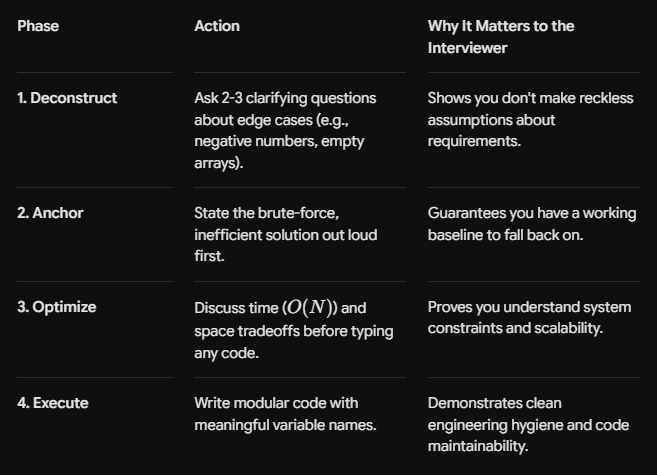
Key insight: Never write a single line of code until the interviewer explicitly agrees with your proposed optimized approach in Step 3.
The Silent Rubric: Communication Under Pressure
Interviewers are filling out a rubric while you code. Half of that rubric is technical correctness, but the other half is communication. Can you "think aloud" effectively? If they give you a hint, do you get defensive or do you seamlessly integrate it into your logic?
This is where traditional preparation completely breaks down. You cannot practice the pressure of an interview by yourself in a quiet room. You need a feedback loop.
This exact gap is why we built Rehurz.
Instead of relying on busy friends for mock sessions or crossing your fingers hoping you won't freeze, you need environment simulation. Rehurz allows you to jump into an AI-powered mock technical round at any time. It doesn't just evaluate if your code compiles; the AI assesses how well you explain your time-complexity tradeoffs out loud and catches when your verbal explanation gets muddy. Practicing the pressure ensures that the pressure won't break your logic on the big day.
The Final Phase of Prep
The final two weeks before your interview shouldn't be spent cramming more algorithms. They should be spent simulating the environment.
- Stop using the "Run" button: Force yourself to dry-run your code manually line-by-line, explaining the state of your variables out loud.
- Simulate the pressure: Put the 4-step framework to the test. Try a mock interview session and see if your communication holds up when someone (or an AI) is actively evaluating you.
Your technical skills get you the interview, but your communication gets you the offer.
Want more Rehurz in your Google results?
Add Rehurz as a preferred source